Carmichael Road Watermain Replacement Project
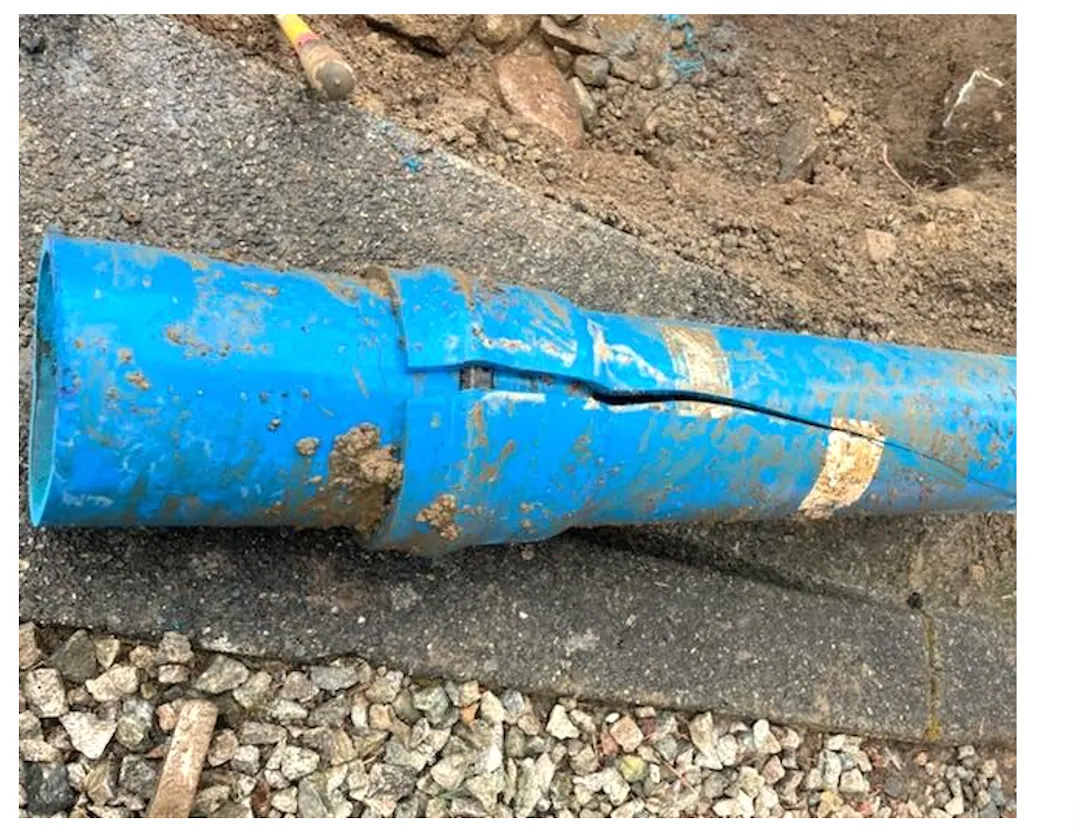
Carmichael Road broken watermain image

The Regional District of Nanaimo (RDN) is proposing to replace the watermain on Carmichael Road to help protect safe, reliable water service in the Nanoose Bay Peninsula Water Service Area. This page provides key facts about the proposed project, estimated cost, the approval process, and how to stay informed.

Project at a Glance

  • Project Name: Carmichael Road Watermain Replacement
  • Location: Carmichael Road, Nanoose Bay
  • Purpose: Replace a watermain that has failed twice
  • Estimated cost: $1,753,924
  • Proposed funding: Municipal Finance Authority of British Columbia (MFA) borrowing over 10 years, subject to elector approval
  • Vote date: October 17, 2026

Background and Project Need

The Carmichael Road watermain is part of the drinking water system that serves the Nanoose Bay Peninsula Water Service Area. This watermain has experienced two major failures, in 2019 and 2025, both of which caused significant road damage and emergency repair costs. Based on these repeated pipe failures, the RDN is proposing to replace the entire length of watermain on Carmichael Road as a long-term solution.


What Is Proposed

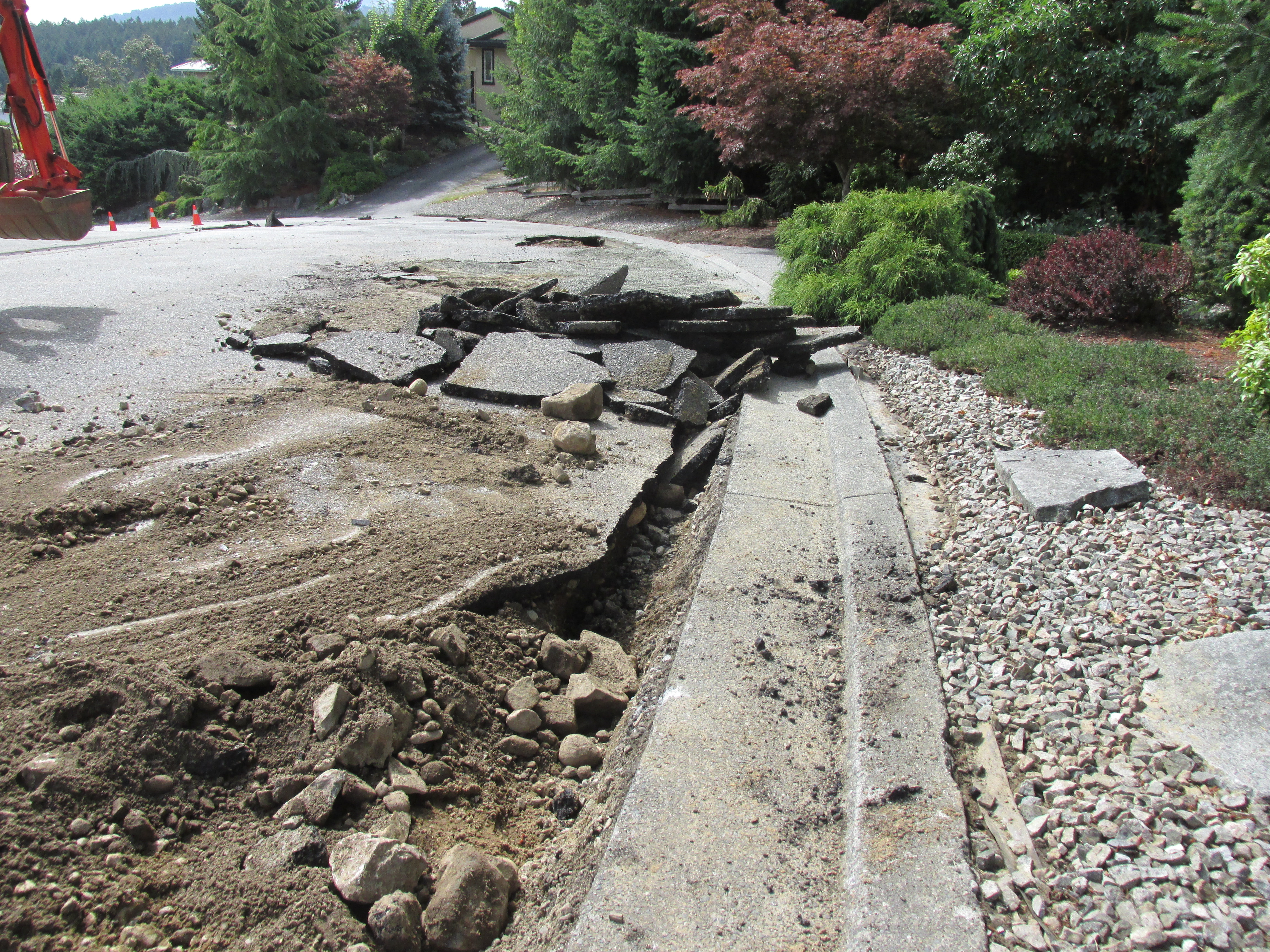
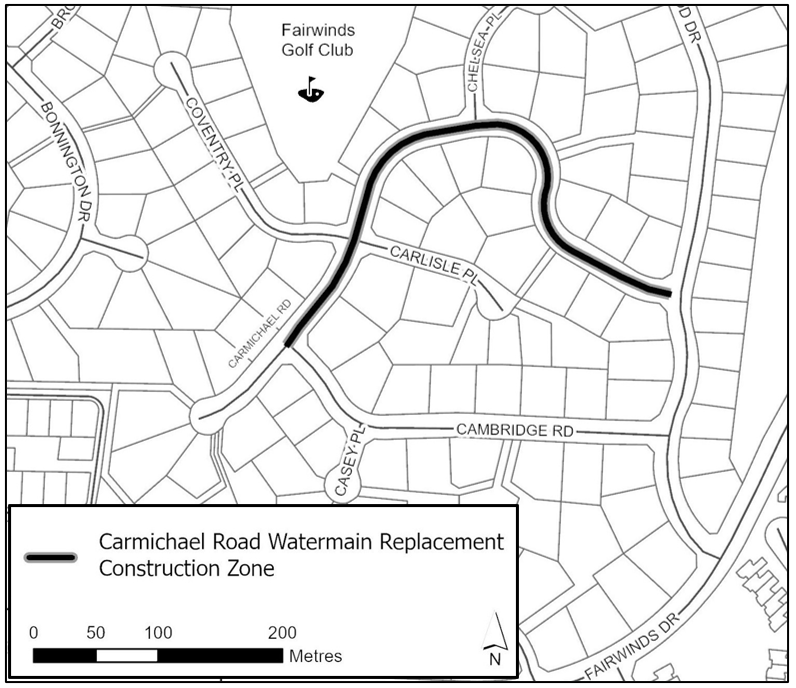
Temporary pavement patches were made during emergency repairs. The proposed project on Carmichael Road is to replace all of the watermain pipes and related utilities between Collingwood Drive and Cambridge Place, and to fully restore the curb, sidewalk, road base and pavement.

Proposed Project Location
Why This Project is Essential

  • A long-term solution is required to mitigate the risk of further pipe breaks in this area.
  • Public health is at risk from water system contamination each time there is a watermain break.
  • Replacing the entire watermain will help avoid repeated road damage and additional repair costs.
  • Asphalt heaving and erosion of the road base and adjacent sidewalk base materials were not fully addressed during emergency repairs.
  • The RDN is liable for damage claims from this known watermain corridor.
  • Correspondence has been received from the Ministry of Transportation and Transit indicating that the repeated pipe breaks on Carmichael Road pose a significant risk to the response times for Emergency Services vehicles (police, fire, ambulance).
  • Island Health could mandate the replacement of the Carmichael Road watermain under the terms of their Operating Permit.
  • Without borrowing funds from the MFA, property owners would face a significant increase in parcel taxes in the short-term in order to build up the reserve fund required to complete this watermain replacement within 5 to 10 years’ time.

Project Cost

The estimated watermain replacement project budget is $1,753,924. Based on the current MFA lending rate and a 10-year repayment period, the estimated cost would be approximately $86 per year per property, for 2,574 properties. Final costs will depend on the borrowing rate and actual construction costs, but the borrowing amount would not exceed the amount approved by electors.

How Funding Would Work

Elector approval is required before the RDN can borrow funds for this project. A referendum is planned to be held with the general local election on October 17, 2026. Eligible electors in the Nanoose Bay Peninsula Water Service Area will be asked whether they support authorizing the RDN to borrow up to $1,753,924 and repay that amount over 10 years through taxation.

Community Information Session / Get Involved

Residents are invited to attend a community information session to learn more about the proposed project, ask questions and share feedback.

  • Date: Monday, September 14, 2026
  • Time: 5 to 7 p.m.
  • Location: Nanoose Place, 2925 Northwest Bay Road, Nanoose Bay, B.C.

Stay Informed

  • Check this page regularly for project updates, key dates and What's New as the project moves forward.
  • Browse the document library to review reports, notices, letters, maps, photos and other background materials related to the proposed watermain replacement.
  • Subscribe for email updates by clicking on "Stay Informed" if you would like to be notified when new information is posted or important milestones are reached.
  • Review the FAQs for quick answers to common questions about watermain condition, project options, financing and the referendum process.
  • If you have a question that is not covered here, please ask in the Question & Answers section. RDN staff will do their best to provide helpful information and share answers that may be useful to other residents as well.

The Regional District of Nanaimo (RDN) is proposing to replace the watermain on Carmichael Road to help protect safe, reliable water service in the Nanoose Bay Peninsula Water Service Area. This page provides key facts about the proposed project, estimated cost, the approval process, and how to stay informed.

Project at a Glance

  • Project Name: Carmichael Road Watermain Replacement
  • Location: Carmichael Road, Nanoose Bay
  • Purpose: Replace a watermain that has failed twice
  • Estimated cost: $1,753,924
  • Proposed funding: Municipal Finance Authority of British Columbia (MFA) borrowing over 10 years, subject to elector approval
  • Vote date: October 17, 2026

Background and Project Need

The Carmichael Road watermain is part of the drinking water system that serves the Nanoose Bay Peninsula Water Service Area. This watermain has experienced two major failures, in 2019 and 2025, both of which caused significant road damage and emergency repair costs. Based on these repeated pipe failures, the RDN is proposing to replace the entire length of watermain on Carmichael Road as a long-term solution.


What Is Proposed

Temporary pavement patches were made during emergency repairs. The proposed project on Carmichael Road is to replace all of the watermain pipes and related utilities between Collingwood Drive and Cambridge Place, and to fully restore the curb, sidewalk, road base and pavement.

Proposed Project Location

Why This Project is Essential

  • A long-term solution is required to mitigate the risk of further pipe breaks in this area.
  • Public health is at risk from water system contamination each time there is a watermain break.
  • Replacing the entire watermain will help avoid repeated road damage and additional repair costs.
  • Asphalt heaving and erosion of the road base and adjacent sidewalk base materials were not fully addressed during emergency repairs.
  • The RDN is liable for damage claims from this known watermain corridor.
  • Correspondence has been received from the Ministry of Transportation and Transit indicating that the repeated pipe breaks on Carmichael Road pose a significant risk to the response times for Emergency Services vehicles (police, fire, ambulance).
  • Island Health could mandate the replacement of the Carmichael Road watermain under the terms of their Operating Permit.
  • Without borrowing funds from the MFA, property owners would face a significant increase in parcel taxes in the short-term in order to build up the reserve fund required to complete this watermain replacement within 5 to 10 years’ time.

Project Cost

The estimated watermain replacement project budget is $1,753,924. Based on the current MFA lending rate and a 10-year repayment period, the estimated cost would be approximately $86 per year per property, for 2,574 properties. Final costs will depend on the borrowing rate and actual construction costs, but the borrowing amount would not exceed the amount approved by electors.

How Funding Would Work

Elector approval is required before the RDN can borrow funds for this project. A referendum is planned to be held with the general local election on October 17, 2026. Eligible electors in the Nanoose Bay Peninsula Water Service Area will be asked whether they support authorizing the RDN to borrow up to $1,753,924 and repay that amount over 10 years through taxation.

Community Information Session / Get Involved

Residents are invited to attend a community information session to learn more about the proposed project, ask questions and share feedback.

  • Date: Monday, September 14, 2026
  • Time: 5 to 7 p.m.
  • Location: Nanoose Place, 2925 Northwest Bay Road, Nanoose Bay, B.C.

Stay Informed

  • Check this page regularly for project updates, key dates and What's New as the project moves forward.
  • Browse the document library to review reports, notices, letters, maps, photos and other background materials related to the proposed watermain replacement.
  • Subscribe for email updates by clicking on "Stay Informed" if you would like to be notified when new information is posted or important milestones are reached.
  • Review the FAQs for quick answers to common questions about watermain condition, project options, financing and the referendum process.
  • If you have a question that is not covered here, please ask in the Question & Answers section. RDN staff will do their best to provide helpful information and share answers that may be useful to other residents as well.

Questions and Answers

If you have any questions about the process or project, please add them here and someone will be back to you with a reply shortly.

Email
loader image
Didn't receive confirmation?
Seems like you are already registered, please provide the password. Forgot your password? Create a new one now.
  • This is not the first time we are being asked for funds to repair substandard utilities installed in Fairwinds. Why did the RDN accept Fairwinds into the RDN when substandard utilities existed? Since it was all councillors who accepted the substandard utilities shouldn't all of the RDN pay? WE are being force to pay for a pool in Qualicum that almost no one from Fairwinds uses. Are the 51 lots in Gracewood included to pay for the project? Given Fairwinds record of substandard utility installations, did a RDN engineer inspect the installation of the Gracewood utilities during construction?

    RNK asked about 1 month ago

    1. We don’t have sufficient information to conclude that the utilities that were originally installed were substandard. The typical service life for watermain pipe is assumed to be 50 years. However, the actual service life can vary significantly. Some watermains remain in service for an additional 10 to 20 years beyond their expected lifespan, while others may require replacement before reaching 50 years of age. The actual longevity of a watermain depends on several factors, including pipe material, soil and site conditions, installation quality, and operating pressures, etc.

    2. The infrastructure is owned by the Nanoose Bay Peninsula Water Service Area and funded by the taxpayers.

    3. Yes, the Gracewood lots will be included for loan repayment. 

    4. There are proper QA/QC processes in place to ensure adherence to the RDN utility standards.

  • How will the 1.7 million dollar charges be fairly allocated to the residents of each of the 2574 properties? Will the assessment of charges be equally divided between each property or will the charges be prorated based on some other measure (ie. BC Assessed value, number of bedrooms, home sq. footage)? Example A: a one-bedroom condo vs. a modest three-bedroom bungalow vs six-bedroom luxury home. Would all three of these individual properties have same charge allocated to them for these estimated repairs? If so, this would not be fair way to allocate charges. How will the allocation of repair charges be applied to local commercial properties in the area? Thanks

    NH asked about 2 months ago

    Under this bylaw, the costs associated with providing this service are recovered through a parcel tax, with each property within the service area paying an equal share of the total costs. This parcel tax applies to all eligible properties within the service area, including commercial properties.

  • Hi, thanks for the opportunity to ask questions in order to obtain a better understanding. How did the RDN specifically come up with 2574 properties to be funding this project? What was the specific criteria for choosing them? What about the other pre maturely failing water mains that are in the Fairview neighborhood that will need repairs, will the same 2574 property owner have to fund the repair of those too? Why are not all RDN property owners expected to help fund this specific project? Why are the properties that are directly related to this section of failing water main not having to pay for all of the repairs to it?

    NH asked about 2 months ago

    1. The 2,574 properties represent the current number of parcels within the Nanoose Bay Peninsula Water Service Area (NBPWSA). The only criteria is that these properties are included in the NBPWSA and collectively fund the operation, maintenance, and capital improvements of the NBPWSA water system.

    2. At this time, the RDN is not aware of any other prematurely failing watermains in the Fairwinds neighbourhood (assuming "Fairview" was intended to refer to Fairwinds). Any future water system infrastructure repairs or replacements would be funded by all parcels within the Nanoose Bay Peninsula Water Service Area and, currently, this service area includes 2,574 parcels. 

    3. Each service within the Regional District is operated as a financially separate entity under the Local Government Act. As a result, properties that do not participate in or receive a particular service do not contribute to its costs. This ensures that the costs of providing a service are borne by the properties that benefit from that service.

    4. Although the watermain is located in a specific area, it forms part of an interconnected water distribution system that serves the entire Nanoose Bay Peninsula Water Service Area. A failure at any point in the system can affect overall service reliability, water quality, and operational performance for all users. In addition, repeated emergency repairs, service disruptions, and ongoing road restoration work increase operating and maintenance costs for the water system as a whole. Replacing this watermain can help reduce future repair costs, improve system reliability, and avoid more costly emergency interventions. Since each water system has a single operational budget, these costs are ultimately borne by all users within the service area.

  • 1. Who installed the watermain originally? What responsibility is there for its failure? 2. Is the RDN not insured for such events? 3. Why do we keep issuing new building permits when our infrastructure can't sustain them? 4. I live a long way from this problem, so why do I have to help fix it? 5. More money from my pocket to the RDN. This has been an annual feature for the past twenty years, but I'm not sure that I'm receiving more (or better) service. 6. I shall be out of town for the upcoming meeting. My comments above are a knee-jerk reaction on receiving your notification.

    nuts asked about 2 months ago

    1. This watermain was originally constructed by the Carmichael Road/Collingwood Dr subdivision developer (or a contractor hired by this developer) as part of the subdivision development conditions and, later, transferred the ownership to the RDN for operation and maintenance. 

    2. While we have a reasonable understanding of the factors contributing to the watermain failure, we do not have sufficient evidence to conclusively establish negligence or assign liability to any party involved in the original construction. In addition, watermain construction is typically subject to a maintenance or warranty period of 1-2 years, during which the contractor is responsible for correcting any deficiencies. This watermain was installed approximately 36 years ago, in 1990, and any applicable warranty period expired decades ago.

    3. Our municipal insurance policy does not cover repairing or replacing a watermain that has failed due to deterioration, settlement or historical construction deficiencies.

    4. The failures of the Carmichael Road watermain have not been caused due to a capacity issue. New subdivisions are approved only after ensuring sufficient capacity is in the existing infrastructure. 

    5. A watermain failure at any location within the water system can affect the reliability and safety of the entire system. Watermain breaks can increase the risk of contamination entering the distribution network and may impact service delivery to all users in the water system. In addition, repeated emergency repairs, service disruptions, and ongoing road restoration work increase operating and maintenance costs for the water system as a whole. Addressing the underlying issue through a permanent solution can help reduce future repair costs, improve system reliability, and avoid more costly emergency interventions. Since the Nanoose Bay Peninsula water system has a single operational budget, these costs are ultimately borne by all users within the Nanoose Bay Peninsula Water Service Area. 

  • What are the total number of properties subject to the added $86/year

    Fmitchcott asked about 2 months ago

    The $86/year repayment amount was estimated based on 2,574 properties. The final annual repayment amount will be calculated based on the exact number of properties in the Nanoose Bay Peninsula Water Service Area at the time of project completion.

  • What is the length of the watermain replacement area, and the size of the watermain being used to replace the existing watermain?

    Joanne Yellow Sheet asked 3 months ago

    The length of watermain proposed for replacement is 510 m, and the proposed pipe size is 200 mm (8-inch) diameter, which is the same as the existing pipe size. 

  • What is the estimated length of time necessary to complete this project and what will the impact be for vehicle traffic on Carmichael

    Bob and Sandy Atkinson asked about 2 months ago

    1. This project should take approximately two years from initiation to completion. If the referendum is successful, archaeological investigations, surveying, detailed design, and tendering activities would be carried out in 2027 and the construction would take place in 2028. Construction is currently estimated to take approximately 5-8 months to complete, although the schedule may vary depending on factors such as the contractor’s schedule, permit approval, material procurements, and site conditions, etc.

    2. Some disruption in vehicle traffic can be expected during construction. Prior to the start of construction, a traffic management plan will be completed to help minimize impacts on local residents and road users. In addition, a construction permit from the Ministry of Transportation and Transit will be obtained before work begins.

  • I think we are all hoping this section of pipe replacement is the only section that will have to be replaced well ahead of its projected lifespan. You have stated that the leaks were due to poor workmanship and QA/QC procedures during the construction in 1990. It must be possible to find out from the Developer who the contractor & sub contractors were to try to hold accountable? This should be a lesson to all Engineers, contractors, sub contractors and inspectors that QA/QC is important to ensure that shortcuts are not taken at the future expense of the taxpayer. What steps are the RDN taking to ensure that current new developments, that the RDN will be adopting, have sufficient inspection and insurance to cover the taxpayer?

    P&JHobern asked about 2 months ago

    Poor workmanship and inadequate Quality Assurance & Quality Control (QA/QC) practices may have contributed to this premature watermain failure; however, it cannot be concluded with certainty that these are the only contributing factors. Watermain installation standards for bedrock conditions and steep-sloped terrain have also evolved significantly over the past 30 to 40 years. Current construction practices are more rigorous and comprehensive, incorporating detailed design reviews, ongoing site inspections, and stringent QA/QC testing to verify that construction activities comply with applicable standards, specifications, and industry best practices.

    The standard warranty and maintenance period is one year following construction. During this period, the original contractor is responsible for repairing any deficiencies identified in the work.

  • What would the annual cost to affected properties be if RDN accumulated a reserve for this project instead of borrowing. More or less than the $86 quoted for repay borrowed funds? What outside engineering or other professional work has been initiated to support the immediacy of this project? Why can't it be deferred? If this area needs replacing are there others which also will need replacing and what steps is RDN taking to address future infrastructure replacements?

    taxus200 asked about 2 months ago
    1. The annual cost to each property in the case of reserve accumulation can’t yet be determined. The cost would depend on the planned construction year, inflation, cost escalation, and number of properties in the service area in the future years. 
    2. Based on our assessment, implementing this project in 2027-2028 is the most responsible course of action.  Construction cost escalation is expected to continue due to inflationary increases and delaying the project would almost certainly increase the operational costs to taxpayers. 
    3. Following the 2025 watermain break, the provincial Ministry of Transportation and Transit (MoTT) agreed to defer permanent road repairs for a limited period pending replacement of the watermain. If the replacement project is delayed, MoTT may require the RDN to complete permanent road restoration sooner, particularly if road conditions resulting from previous watermain failures continue to deteriorate. Repaving the road without first addressing the deficient watermain would not only increase operational costs but could also expose the RDN to liability related to property damage claims arising from future failures. Such costs would ultimately be borne by taxpayers. Repeated watermain failures also present a public health risk. Each break introduces a potential contamination pathway that could compromise water quality of the entire water system.
    4. At this time, the RDN is not aware of any other prematurely failing watermains in the Fairwinds neighbourhood. 
    5. If long-term borrowing is approved through the referendum, the RDN will retain an external engineering consultant to complete the detailed survey, design, and tender preparation for the watermain replacement project. To date, the preliminary assessment and project development work have been completed by RDN's in-house professional staff. The RDN is also advancing its asset management program to systematically renew infrastructure based on asset condition, risk, and expected service life. Each year, contributions are made to capital reserve funds to support the planned replacement and renewal of infrastructure assets. These reserves are intended to help fund future capital projects and reduce the financial burden on taxpayers over the long term.
  • What is the annual cost to each property if funds are NOT borrowed but instead a reserve is accumulated to fund this project? I am not hearing there is urgency to this project. If there is a signifigant failure while reserves are accumulating then seek to borrow funds.

    taxus200 asked about 2 months ago

    The annual cost to each property in the case of reserve accumulation would depend on the planned construction year, cost escalation, and number of properties in the service area in the future years. Based on our assessment, implementing this project in 2027-2028 is the most responsible course of action. Given that this watermain has had two failures within a relatively short period, it is reasonable to expect additional failures in the near future if the full length of the watermain is not replaced. Since this watermain is located in a steep longitudinal grade, a failure at any point along Carmichael Road would allow water to flow downhill, potentially causing damage to the asphalt over a significant portion of the road. Repeated failures would result in ongoing asphalt repairs and repaving, increasing operational costs that would ultimately need to be funded through taxation. These additional costs would be incurred on top of the tax increases required to support annual reserve contributions if long-term borrowing is not approved through the referendum. In addition, following the 2025 watermain break, the Ministry of Transportation and Transit (MoTT) agreed to defer permanent road repairs for a limited period pending replacement of the watermain. If the replacement project is delayed, MoTT may require the RDN to complete permanent road restoration sooner, particularly if road conditions resulting from previous watermain failures continue to deteriorate. Repaving the road without first addressing the deficient watermain would not only increase operational costs but could also expose the RDN to liability related to property damage claims arising from future failures. Such costs would ultimately be borne by taxpayers. Repeated watermain failures also present a public health risk. Each break introduces a potential contamination pathway that could compromise water quality of the entire water system.

    Long-term borrowing through the Municipal Finance Authority is the most cost-effective funding approach. Construction cost escalation is expected to continue due to inflationary increases and the delaying of the project would certainly increase the operational cost, as explained above.

Page last updated: 08 Sep 2026, 02:05 PM