
FAQ
Property Information
Where is Hamilton Marsh?
Hamilton Marsh is located south of the Town of Qualicum Beach bounded by Hilliers Road on the north and west sides, Memorial Avenue on the east side and the Island Corridor Foundation rail corridor on the south side.
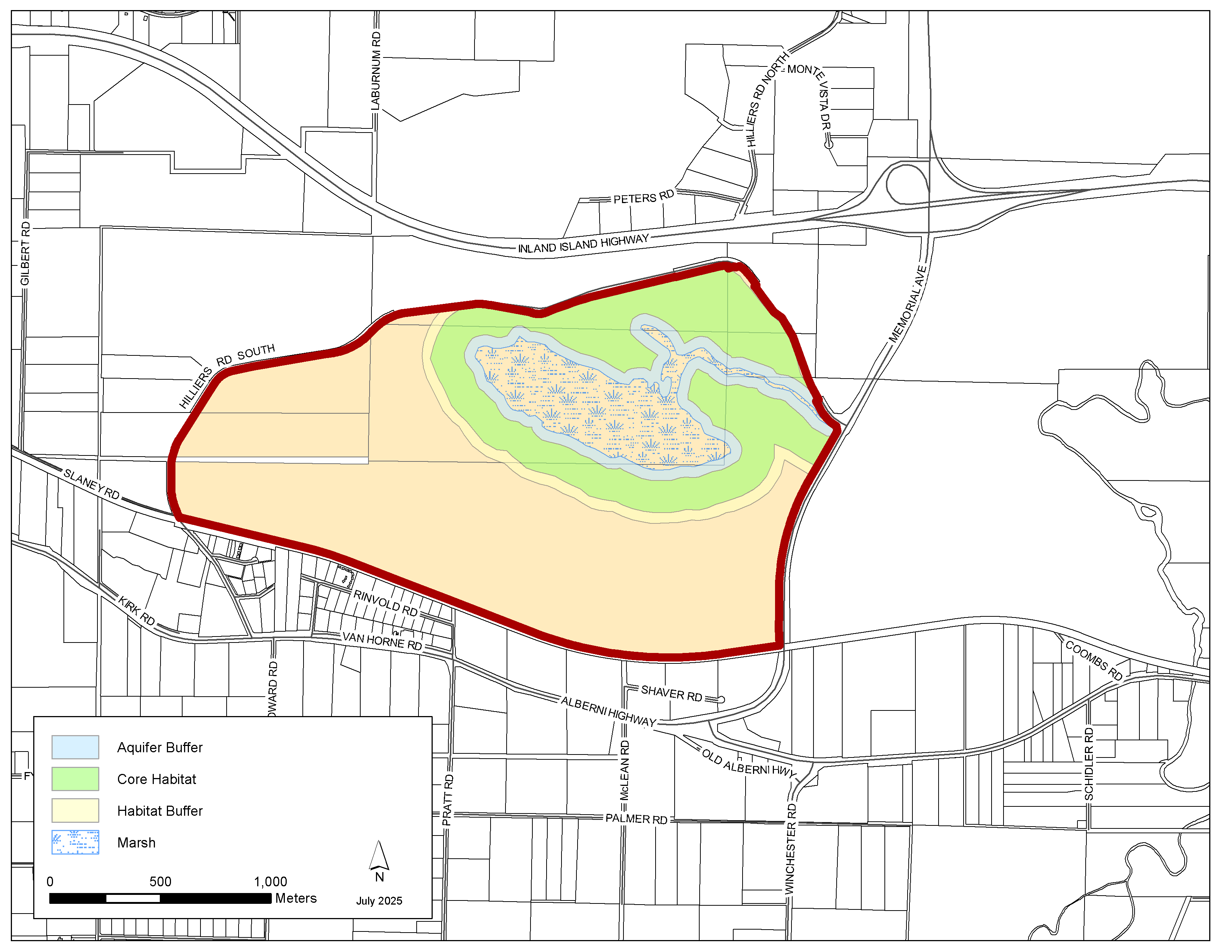
Most of the lands are located with RDN Electoral Area F and a segment within Electoral Area G.
How can I learn more about Hamilton Marsh?
The Hamilton Wetlands and Forest Preservation Society have a great website you can visit to learn more about the area hamiltonwetlands.com.
How big is the property?
The property is approximately 364 hectares. Hamilton Marsh itself is approximately 36 hectares in size and the surrounding forest area make up the remaining 328 hectares.
Who owns Hamilton Marsh now?
Hamilton Marsh is currently owned by Island Timberlands and managed under Mosaic Forest Management.
Why does the RDN want to purchase the Hamilton Marsh?
Acquiring Hamilton Marsh as a regional park and conservation area has been a priority for the Regional District of Nanaimo (RDN) for many years. Acquiring the approximately 360 hectares of land would help protect vital ecosystems and enhance regional parkland offerings.
Securing this area would represent a significant step within British Columbia toward achieving Canada’s 30 by 30 conservation target which aims for the effective protection and management of 30 per cent of Canada’s land and water by the year 2030.
How can I get updates?
Subscribe to this project by entering your email address and clicking the SUBSCRIBE button under the Stay Informed microphone image at the bottom of the page. Once you are subscribed, the message will change to: Thank you for subscribing. Once subscribed, you will receive updates directly to your email.
The project page will also be updated as more information becomes available.
Financial Information
- Nanaimo & Area Land Trust
- Mt. Arrowsmith Biosphere Region
- Hamilton Wetlands and Forests Preservation Society
- Ducks Unlimited Canada - Oceanside Chapter
- The Province (in partnership with the Government of Canada)
- Nature Trust of BC
- Sitka Foundation
What is the total cost of the acquisition?
Mosaic Forest Management accepted an offer of $30 million for the 360 hectares of land. In February Mosaic agreed to revise the purchase terms to $28 million.
How will the purchase be funded?
The funding sources include $4 million from the Regional Parks and Trails reserve funds, $2.8 million from external fundraising and $21.2 million from long-term borrowing.
Who pays for the purchase?
Hamilton Marsh would be considered a Regional Park and Conservation Area therefore, would be purchased through the Regional Parks and Trails service area.
How will this purchase effect property taxes?
The long-term borrowing of $21.2 million will require debt repayment costs for 20 years. The estimated annual debt repayment costs of each participating area are outlined in the table below. The amounts in the table assume a borrowing rate of 4.8% as per the Municipal Finance Authority and a 20-year borrowing term. The average residential value is based on BC Assessment 2026 Completed Roll Assessments. Interest and assessment values are subject to change at time of borrowing.
The property it will be maintained as a regional park and conservation area. After the purchase is complete, a management plan would be developed in collaboration with the funding partners and future costs of maintaining the property will be determined.
Participants | 2026 Average Residential Value ($) | Annual Debt Repayment ($) | Res. Cost per $100,000 ($) | Repayment per Avg Household ($) |
City of Nanaimo | 777,123 | 937,141 | 2.37 | 18.42 |
District of Lantzville | 1,157,604 | 43,140 | 1.98 | 22.92 |
City of Parksville | 786,182 | 147,809 | 2.05 | 16.12 |
Town of Qualicum Beach | 953,821 | 103,265 | 2.01 | 19.17 |
Electoral Area A | 821,241 | 72,943 | 2.27 | 18.64 |
Electoral Area B | 684,200 | 52,734 | 1.92 | 13.14 |
Electoral Area C | 1,092,481 | 40,651 | 1.87 | 20.43 |
Electoral Area E | 1,289,431 | 86,702 | 1.81 | 23.34 |
Electoral Area F | 735,877 | 79,128 | 2.30 | 16.93 |
Electoral Area G | 1,019,942 | 86,033 | 2.09 | 21.32 |
Electoral Area H | 928,876 | 50,267 | 1.92 | 17.83 |
Total |
| 1,699,813 |
|
|
Is the RDN required to hold a referendum for the long-term borrowing?
No, the RDN is not required to hold a referendum for this long-term borrowing. Section 3 of the Regional District Liabilities Regulation in the Local Government Act allows regional park and regional trail borrowing without elector approval if the total of the outstanding amount of borrowing for the service and the amount proposed to be borrowed will not exceed the greater of $5 Million, and an amount equal to $5 per $1,000 of assessed value.
The current borrowing amount of the Regional Parks and Trails Service plus the $21.2 million proposed borrowing are calculate to significantly lower than $5 per $1,000 of assessed value, the current calculation is $329 million. Therefore, the RDN is well within the borrowing limits and can proceed without requiring a referendum.
Who is the RDN partnering with?
The RDN has been successful in creating partnerships with
Subdivision Information
What is the purpose of the Hamilton Marsh Subdivision Application?
The Hamilton Marsh site is currently comprised of seven separately titled parcels, six of which straddle the road right of ways. A subdivision is required to sever the parcels within the road boundaries that the RDN has agreed to the purchase, from the sections that lie on the other side of the roads.
Why is the subdivision necessary?
The subdivision is required as part of the conditional Contract of Purchase and Sale (CPS) with Island Timberlands Limited Partnership. It allows the RDN to purchase and retain the preferred parcels within the road boundaries.
Who approves the subdivision, and what regulations apply?
Subdivision approvals within the Agricultural Land Reserve (ALR) fall under the jurisdiction of the Agricultural Land Commission (ALC). However, the Provincial Approving Officer (PAO) can approve subdivisions that meet certain criteria under ALR regulations.
What are the benefits of the proposed two-lot concept?
The two-lot concept offers flexibility for funding partnerships by separating the marsh area from the forested area. This approach also aligns with regulatory requirements and facilitates the creation of the conservation site.
How is the public being notified?
Notices have been posted on all seven lots as part of the Regional District’s subdivision notification requirements. The notice is also posted in the Background Documents section. Additional information will be shared here on the RDN Get Involved project page as it becomes available.
Does the subdivision application change the land zoning?
The subdivision application does not automatically change the land use zoning. The property remains under its existing zoning designation until a formal rezoning process is initiated.
The RDN’s intent is to acquire the property as a Regional Park and Conservation Area. No change in zoning is required for this purpose, as parks are a permitted use in every zone under the current zoning bylaw.
Contributing to the Purchase
How can I contribute to the purchase of Hamilton Marsh?
The RDN would like to thank Nanaimo & Area Land Trust and Mt. Arrowsmith Biosphere Region. Their fundraising efforts have helped to make this purchase a reality.
The fundraising campaign is now complete.
What happens to my donation if the purchase is not completed?
The purchase has been successful. The RDN is grateful to the community for the overwhelming support.