
Our Changing Coast

Project Background
The Regional District of Nanaimo's (RDN) coastal areas are home to many residents, essential services like roads and utilities, diverse and sensitive ecosystems, and some of our most scenic landscapes. However, these areas are also potentially vulnerable to coastal hazards like flooding, erosion, and storm events impacting public and private lands.
In the RDN, coastal hazards like flooding, erosion, and storm events can damage homes and infrastructure, cause road closures, wash away agricultural land, disrupt supply chains, and impact our environment. These coastal risks affect our safety, economy, and quality of life--and are increasing, impacting many people living and working in our region.
To help address these challenges and build resilience to coastal risks, the RDN has initiated a four-year program called Our Changing Coast. This will involve technical work, engagement, and partnership building, with the end goal of creating a Coastal Climate Adaptation Strategy for our region.
Our Changing Coast Objectives
Improve our understanding of coastal risks from sea level rise, flooding, and erosion to our area and how these might evolve under climate change.
Identify the best ways our region can prepare for and respond to these changing risks.
Build sound regional collaboration to tackle these shared challenges FAQ
1. Improving Our Understanding
Coastal risks are created when coastal hazards such as flooding and erosion affect people, property, buildings, sensitive habitats, cultural sites, infrastructure, or other valued things. Risks can vary from place to place, even along the same coastline. We also expect that risks will change over time, through sea level rise and more intense storm effects under climate change. By understanding where risk is present, and how it might change over time, we can start to plan proactively on how to prepare and respond. This will help us make better decisions about where to build and what to do to protect our communities and our coastal environment.
One of the most important places to start is to understand how people living in the RDN are experiencing coastal risks, what they value and want to protect along our coastlines, and any questions they might have on the topic. As an initial first step, we conducted a Coastal Risk Survey in the fall of 2024 for residents to share their experiences and help us better understand their perceptions, concerns and questions related to coastal risk in the RDN. The results will help us develop a communications and engagement approach that supports continued conversations about coastal risks in our area and helps us connect residents with the information they have told us they would like to have.
2024 Public Survey on Coastal Risks
One of the most important places to start is to understand how people living in the RDN are experiencing coastal risks, what they value and want to protect along our coastlines, and any questions they might have on the topic. As an initial first step, we conducted a Coastal Risk Survey in the fall of 2024 for residents to share their experiences and help us better understand their perceptions, concerns and questions related to coastal risk in the RDN. The results have helped us develop a communications and engagement approach that supports continued conversations about coastal risks in our area and helps us connect residents with the information they have told us they would like to have.
2025 Coastal Risk and Erosion Hazard Assessments
In 2025, the RDN completed two technical studies to better understand coastal hazards and risks and how they might change over time. The coastal risk assessment identifies what might get damaged from coastal flooding as climate change progresses. The coastal erosion hazard assessment identifies where there is more risk of shoreline loss or growth.
To learn more about what a coastal risk assessment and coastal hazard erosion assessment are, visit the FAQs.
Study Area for Coastal Risk and Erosion Assessment
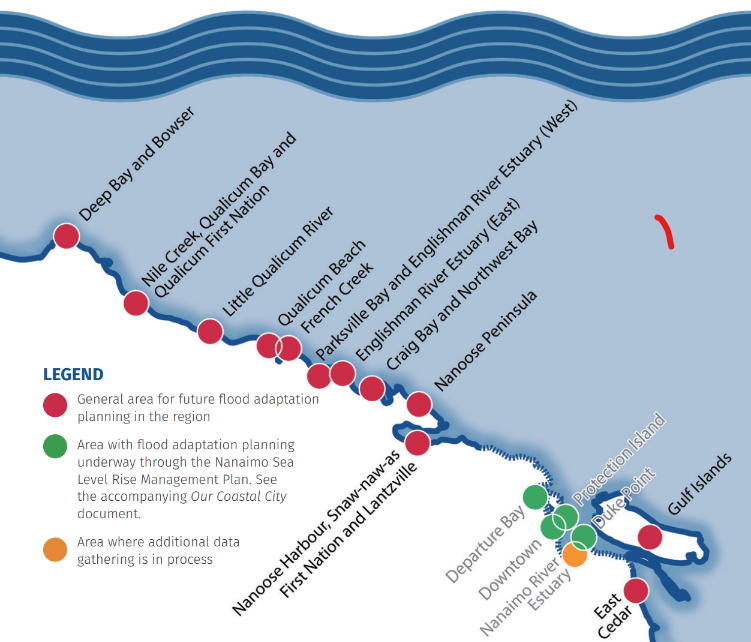
Although Our Changing Coast includes the entire RDN, the technical study area for the Coastal Risk and Erosion Assessments do not include City of Nanaimo and some Snuneymuxw First Nation Reserve lands, which are being assessed by the City of Nanaimo separately through Our Coastal City: Nanaimo's Sea Level Rise Management Plan. A separate but related project for Nanaimo was necessary due to differing methodology from earlier studies and the need for more Nanaimo-specific information. The Our Changing Coast initiative is being done in coordination with Our Coastal City.
2. Identifying Good Ways to Prepare and Respond (2026-2027)
In summer and fall 2026, we will explore options for reducing coastal risks and compare their costs and benefits. This work will reflect community values such as public access, healthy coastlines, affordability, and protection of private property, as shared with us through community engagement. We will use an Adaptation Pathways approach, which helps reduce risk while staying flexible over time and keeping costs down. The results of the evaluation will be included in the Coastal Climate Adaptation Strategy.
3. Building Sound Regional Collaboration (2025-2027)
Climate change is a big, shared challenge and addressing it together makes sense. Our Changing Coast brings together First Nations, local governments, senior governments, and others responsible for coastal management to understand shared challenges and develop practical solutions. Collaboration helps avoid duplication, share knowledge and resources, and make better use of limited funding. It also builds the relationships needed for long‑term, cost‑effective coastal adaptation.
4. Regional Coastal Climate Adaptation Strategy
All of the work above will help develop a Coastal Climate Adaptation Strategy for our region. The Strategy will provide a clear path for reducing risks and costs of coastal climate adaptation in our region, identify near term strategic opportunities, and clearly describe roles different organizations will need to play in implementation. The strategy is expected to be completed by the end of 2027.
Want to stay informed and learn more?
- Subscribe through the Stay Informed tab to receive direct email updates
- Visit the Document Library to learn more about the project.
- See our FAQs or What's New tab to better understand this project.
- Register to submit a comment form or ask questions.
- Ask a question in the Q&A tab and we will respond
- Connect with our Team under Who's Listening
- Share this page and spread the word!
Ask us a question about Our Changing Coast
Please submit a question and we will share it along with a response.
We ask that only questions related to the project are asked here. Information provided here will not be shared with the RDN Board of Directors.
To protect your privacy and the privacy of others, please do not include any information that could identify you or another person. Identifying information could include a person’s name, address, email or phone number. Questions that contain personal information will not be published.

-
 Sea Level Rise Adaptation Program – Coastal Floodplain Mapping Overview (2021) report
-
RDN Our Changing Coast Public Survey - What We Heard Engagement Summary (2.25 MB) (pdf)
-
Coastal Risk Assessment Overview Report.pdf (12.6 MB) (pdf)
-
Coastal Erosion Hazard Assessment Report (55.9 MB) (pdf)
-
Staff Report - Our Changing Coast Technical Study Results and Progress Update (517 KB) (pdf)
-
An Introduction to Coastal Climate Adaptation in Our Region (6.61 MB) (pdf)
-
Our Changing Coast Open House Engagement Boards (18.2 MB) (pdf)


-
Email kharris@rdn.bc.ca -
Email jbeaubier@rdn.bc.ca