
2025 Cottle Creek Urban Salmonid Habitat Assessment
Access the full report here
1. Introduction
The Friends of Cottle Creek (FOCC) is a local streamkeeper group comprised of volunteers who came together (as a committee of the Nanaimo and Area Land Trust (NALT)) in 2024 to promote a better understanding of the health of the creek and its supporting ecosystems.
The FOCC received support from the Regional District of Nanaimo’s (RDN) Stewardship Seed Funding to undertake an assessment of the creek’s physical condition, using the Urban Salmonid Habitat Program (USHP) assessment methodology (Michalski, Reid & Stewart, 2001).
2. Study Area & Background
Cottle Creek is located in the City of Nanaimo, with its mouth lying between Departure Creek to the west and Walley Creek to the north. The existence of natural bedrock falls near the stream’s mouth in Departure Bay means Cottle Creek’s Coastal Cutthroat trout (CCT) have never faced competition from salmon species like Coho salmon, which have historically occupied neighbouring streams, including Walley and Departure creeks. Consequently, professional biologists view Cottle Creek CCT as a key element of local biodiversity that merit protection and enhanced stewardship as Nanaimo continues to grow in future years.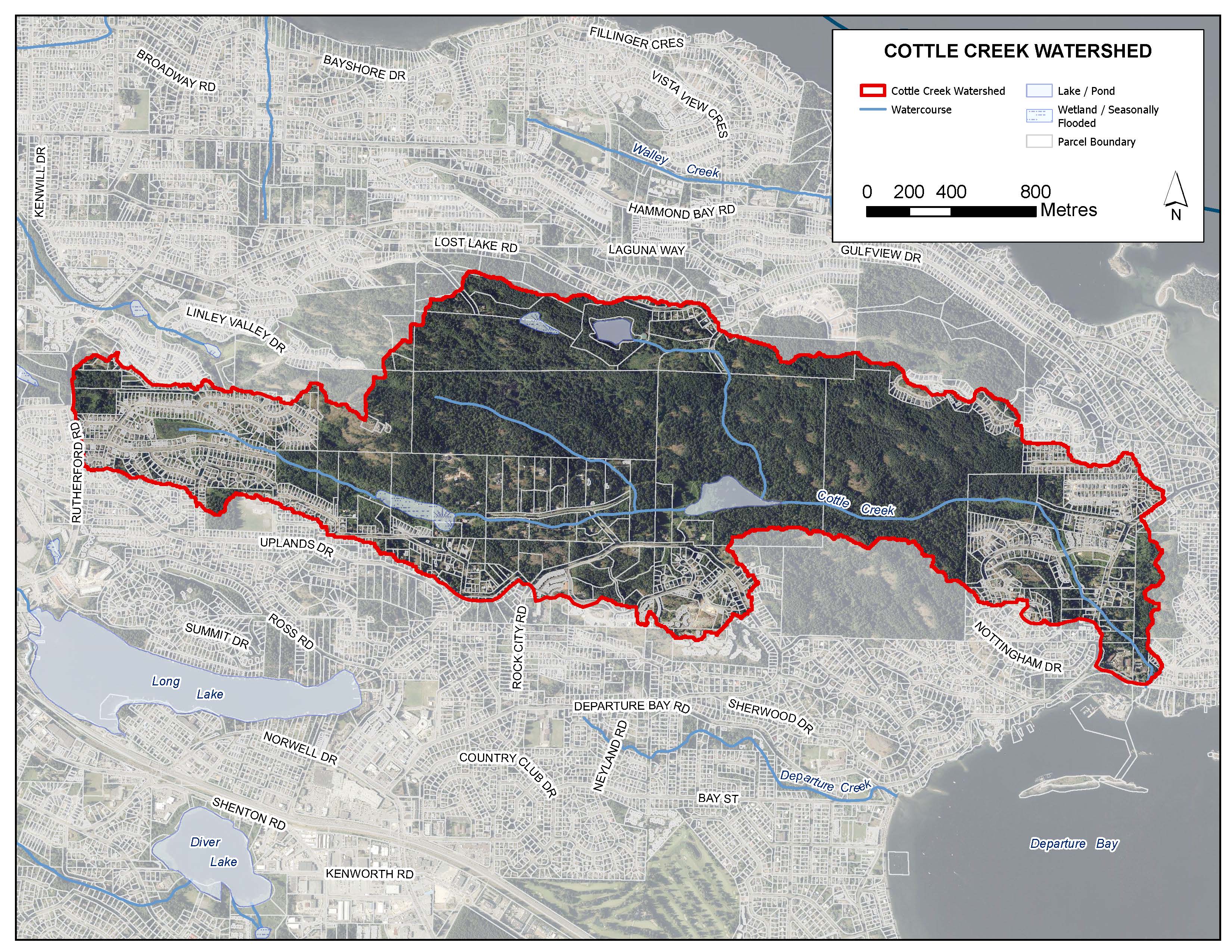
The limited development within the watershed boundary and unique biophysical features of the stream make the Linley Valley and Cottle Creek a one-of-a-kind watershed in the city. These circumstances present an opportunity to use the resident CCT as indicators of watershed sustainability, with their persistence and relative abundance in the watershed being a valuable “indicator” of the health of the aquatic ecosystem.

3. Results
The study noted numerous inhibiting factors to CCT habitation, highlighting the potential benefits of restoration work. These inhibiting factors include lows stream flows; a lack of large woody debris to protect CCT from predators and strong flow; human made and natural barriers to movement; and invasive fish and plants.
4. Conclusions
This study will serve as a foundational reference for future monitoring of the watershed’s health and success of restoration projects. This assessment of fish habitat at 192 individual habitat units along the stream offers a unique and comprehensive way to quantify the condition of Cottle Creek’s aquatic habitat, the functional components necessary to understand how this ecosystem works, and how we can maintain its proper functioning in the long-term.

Thank you for your contribution!
Help us reach out to more people in the community
Share this with family and friends