
Groundwater Connections

Welcome! This is a hub to connect residents in the Regional District of Nanaimo (RDN) with resources and information about their aquifers and groundwater sustainability.
Groundwater connects us - neighbours, communities and the environment.
The RDN is located on the central east coast of Vancouver Island and is located within the traditional territories of the Snuneymuxw, Snaw-naw-as and Qualicum First Nations. Communities within the region include the municipalities of Nanaimo, Lantzville, Parksville and Qualicum Beach, as well as seven unincorporated Electoral Areas. The RDN is home to over 170,000 people. About half of residents in our region rely on groundwater for their water supply. Municipalities, Regional District water services, improvement districts, small water system operators and private well owners use groundwater wells to access water from regional aquifers.
How groundwater connects us
Water is always on the move. Surface water within lakes, rivers, streams and wetlands, as well as groundwater within aquifers underground, are part of a system that continually cycles water between the atmosphere, the surface of the earth and below ground. Groundwater, though often hidden, is a dynamic connector. It stitches together our environment and communities, flowing quietly beneath our feet yet playing a pivotal role in sustaining ecosystems and supporting our livelihoods and communities.
What is an aquifer?
An aquifer is an underground layer of permeable rock, sand, or gravel that stores and transports groundwater. Aquifers can be defined as Bedrock Aquifers or Sand and Gravel Aquifers.

On this page, you can find information and resources about groundwater and groundwater sustainability in the region:
- Learn more through our Groundwater Blog
- Explore local aquifers on Our Regional Aquifers map
- Participate in our Groundwater Connections Check-in for a chance to win a prize
- Find Important Links and Groundwater Resources
- Check out our FAQs
- Explore Regional Groundwater Reports
- Find the latest Publications, including the 2025 State of Our Aquifers - Groundwater Connections Edition
- Learn more through Educational Videos
- And more!
Subscribe to this page to receive notification of updates on the latest blog posts sharing stories, studies and events!
The Regional District of Nanaimo’s Drinking Water & Watershed Protection program's vision is for healthy, safe and resilient water resources in the region. Learn more about Drinking Water & Watershed Protection at dwwp.ca.
-
We want to hear from you! Share how you are connected to groundwater for a chance to win

We want to hear from you! Share how you are connected to groundwater by participating in the Groundwater Connections Check-in where you'll get a chance to tell us your thoughts about the latest Groundwater Connections(External link) publication, and let us know what you are doing to protect and conserve groundwater and how we can support.
By submitting a check-in form, you are helping us to better understand groundwater connections within our region and identify concerns or gaps that may be better supported through education, advocacy, or incentives to adopt groundwater stewardship practices (such as rebate programs).
Submitted Forms may be entered into a draw to win a groundwater-friendly prize! Contest closes on September, 28, 2025.
Find the Groundwater Connections Check-in tab on the home page or click here to submit a form now!
-
Join us at an upcoming WellSmart Workshop - April 23 at 6:00pm at the Meadowood Hall
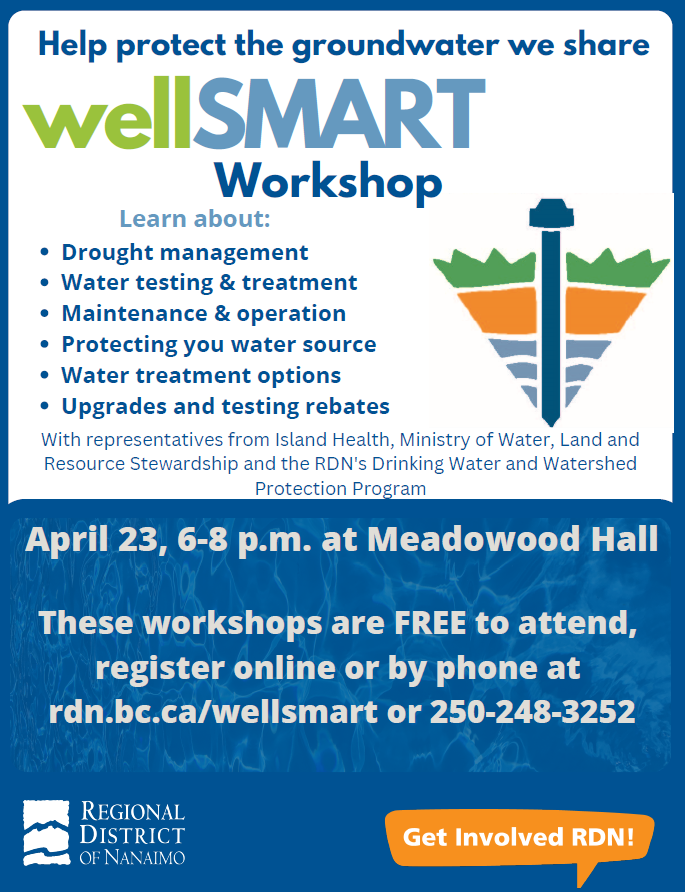
April 23, 2025 at 6:00 p.m. at the Meadowood Hall
Learn how to keep your well in safe running order. Led by the RDN's Drinking Water and Watershed Protection team, Island Health and the Province of BC to learn about:
• Well maintenance and operation
• Protecting your water source
• Water testing and treatment
• Water treatment options
• Drought management
This program is free!
For more information, contact the Outreach Coordinator from the Drinking Water and Watershed Protection program at 1-877-607-4111 or watersmart@rdn.bc.ca(External link).
-
Our Regional Aquifers
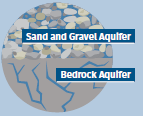
Bedrock aquifers and sand and gravel aquifers behave differently and it is important to monitor both. Bedrock aquifers in our region are generally lower yielding and more vulnerable to drought. In sand and gravel aquifers, productivity and seasonal impacts are variable – some are high yielding with lots of storage; others are more moderate yielding and more susceptible to overpumping and drought. Groundwater levels can vary across an aquifer depending on connectivity or the movement of water between aquifers or to a surface water source.
The table attached shows water level trends in aquifers across the region. Of the 22 aquifers mapped and monitored in the region for groundwater levels in 2024, longer term trends indicate that:
- five show increasing trends where groundwaters levels are observed to be closer to the surface,
- four have stable water levels where no significant changes are seen,
- five sites have declining trends where water levels are moving deeper, and
- eight of the aquifers have variable results where long-term trends are inconsistent across the monitoring sites of an aquifer.

-
The RDN's Volunteer Observation Wells (VOW) Network

It is hard to manage what you don't measure - groundwater is one of those elusive things that is relatively hard to measure, but with the use of groundwater level monitoring equipment, water table depth measurements can be taken on an ongoing basis to understand what is going on underground. This provides a means to observe if water levels are changing over time, to get early warning if supply may be impacted and to better inform development that occurs in our region.
The Drinking Water & Watershed Protection (DWWP) supported two initiatives as a part of this project, a collaboration to expand the B.C. Groundwater Observation Well Network within the region and the creation of the RDN Volunteer Observation Well (VOW) Network.
To expand groundwater level data collection in our region beyond the provincial Observation Wells, 31 private well owners volunteered to have groundwater level monitoring equipment (pressure transducers) installed in their wells. The transducers record level data every 15 minutes; the data is downloaded by RDN staff four times per year. Fourteen of the loggers measure conductivity, to track saline (saltwater) intrusion potential in coastal wells. The monitoring of volunteer wells began in the spring of 2013, with expansions occurring in 2015, 2016 and 2017. It takes a minimum of five - ten years of data collection to begin to discern long-term trends from the information gathered. Since 2020, the RDN has supported annual pre-summer water level analysis reports. The figure below shows the sites included in analysis.
Learn more about the Volunteer Observation Well (VOW) Network at rdn.bc.ca/groundwater-monitoring.

-
The RDN's Drinking Water & Watershed Protection Program

The Drinking Water and Watershed Protection (DWWP) program is a regional service tasked with helping to protect the region’s water resources. Through the DWWP program, we are working to: learn more about water in the region (Water Information & Science), use this information to make better land use decisions (Water-centric Planning and Policy Support) and help communities protect the environment (Water Awareness & Stewardship). All this is achieved through partnerships and collaboration!
The RDN’s Drinking Water and Watershed Protection program goals are to facilitate and/or support regional initiatives that:
- Protect, manage and restore ecosystems and the overall health and functioning of our watersheds and aquifers.
- Safeguard and manage source waters to secure a sustainable drinking water supply.
- Increase water-use efficiency and optimize infrastructure investments for water and wastewater systems.
- Foster the enjoyment and protection of social, cultural, and recreational values and amenities in our watersheds to maintain well-being and quality of life.
- Mitigate and better prepare for climate change impacts on the region’s water resource.
Learn more about the RDN's Drinking Water & Watershed Protection program at rdn.bc.ca/drinking-water-and-watershed-protection.


-
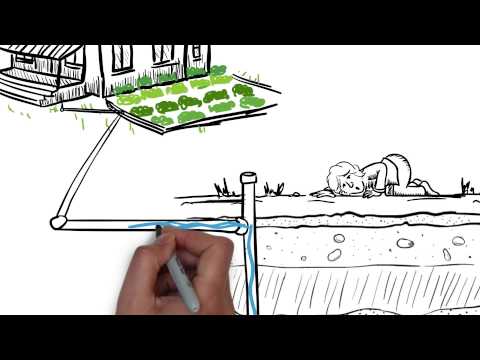 Groundwater is an important source of fresh water for industries, municipalities, farms, and rural homeowners in British Columbia. BC operates a network of over 180 observation wells to track groundwater levels in areas of high use. This information helps us to see how healthy aquifers are so we can make good decisions about groundwater use in BC.
See trends in BC groundwater levels: https://www2.gov.bc.ca/gov/content?id...
Download BC groundwater data: http://www.env.gov.bc.ca/wsd/data_sea...
Learn more about freshwater in BC: http://www.gov.bc.ca/water
Groundwater is an important source of fresh water for industries, municipalities, farms, and rural homeowners in British Columbia. BC operates a network of over 180 observation wells to track groundwater levels in areas of high use. This information helps us to see how healthy aquifers are so we can make good decisions about groundwater use in BC.
See trends in BC groundwater levels: https://www2.gov.bc.ca/gov/content?id...
Download BC groundwater data: http://www.env.gov.bc.ca/wsd/data_sea...
Learn more about freshwater in BC: http://www.gov.bc.ca/water

-
 Water Sustainability Act Brochure (147 KB) (pdf)
-
Licensing Groundwater in BC (162 KB) (pdf)
-
Licensing Groundwater in BC - Q&A (780 KB) (pdf)
-
Groundwater Protection Info for Well Owners Brochure (898 KB) (pdf)
-
Groundwater Protection Info for Well Drillers and Well Pump Installers Brochure (851 KB) (pdf)
-
Before you Drill Brochure (152 KB) (pdf)
-
Saltwater Intrusion Factsheet (438 KB) (pdf)
-
Dry Well Brochure.pdf (422 KB) (pdf)



-
Program Coordinator, Drinking Water & Watershed Protection
Regional District of Nanaimo

Email EForssman@rdn.bc.ca -
Monitoring Network Coordinator - Drinking Water & Watershed Protection Program
Regional District of Nanaimo

Email lfegan@rdn.bc.ca -
Stewardship Coordinator - Drinking Water & Watershed Protection Program
Regional District of Nanaimo

Email CBrugge@rdn.bc.ca